Thursday, October 15, 2020

BLEAK HOUSE

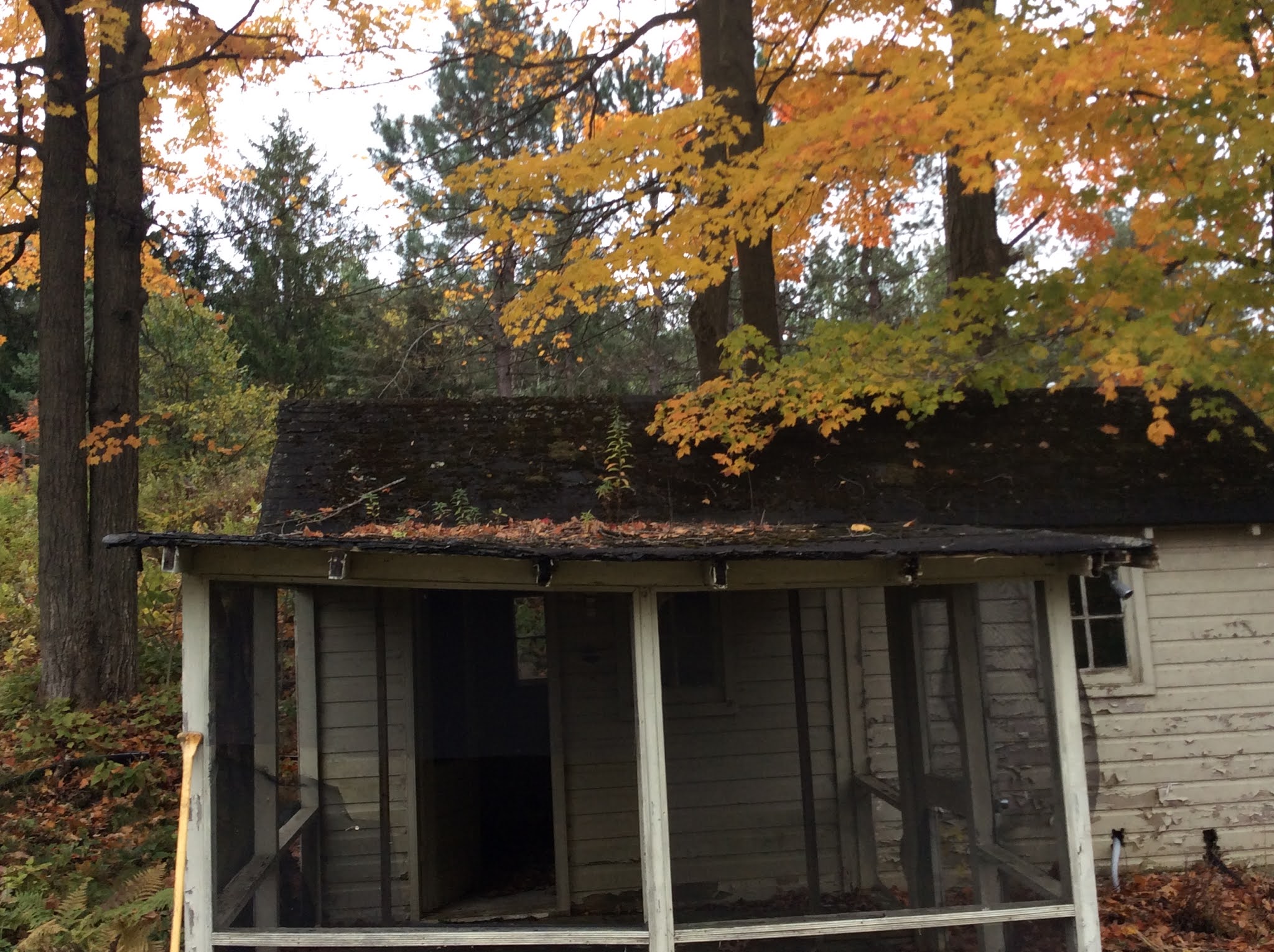
There's a tiny wooden cottage on my property.  I've been avoiding it like the plague.  If you are short-sighted and squint your eyes when looking at it from a distance, it looks almost charming.  On closer inspection, it's not.

Words like squalid, derelict, neglected and horrifying come to mind, the closer I get to it.

Part of the problem is the location.  It sits at the east end of Pond One, at the bottom of a hill.  In fact, its south wall is built right into a hill.  Looking out through the south window, I can almost imagine Peter Rabbit, Mrs. Tiggy Winkle and Tom Kitten going about their business on that hill.

The first spring I was here, the land around this cottage flooded badly, almost knee deep.  It was August before the water had dried out enough for me to come close to the front door.  I imagined that the flooding was because the water level in Pond One was especially high, so I built a partial stone wall around that edge of the pond to keep the water back.  It worked only to a degree, and this year I was still ankle deep in water till late summer.  

The cottage had a poured concrete floor and a screened-in porch with patio stones on top of a cement foundation, and though there was moss growing on the patio stones, the floor of the cottage was elevated and was perfectly dry.

My first instinct was to remove the screening from the porch.  Birds flew in regularly and couldn't find their way out.  It was distressing having to remove the ones that had died in their vain attempt to exit.  The absence of screens helped with air circulation.

In recent years, the cottage has been used as a pump house. There's an elaborate underground network of thick hoses on the property, which enabled former owners who were avid gardeners to water the grounds with pond water.  This meant, though, that one room in the cottage was devoted to pumping equipment, a tank, and lots of heavy duty plumbing.  

There are only two options if you have an outbuilding like this on your property: one, you can have it demolished and hauled away.  It will cost you several thousand dollars and you will have nothing to show for it except a patch of concrete.  Two, you can gut the interior, do whatever repairs you wish, and put a new roof on.  This will also cost you several thousand dollars. Then you can paint the outside and hope that the next owners will be short-sighted and squint a lot.  What you cannot do is nothing.  

I decided on Option Two.  Option Two meant that I would have to summon up the courage to go inside.  Option Two meant that I would have to shed several thousand dollars. I do not like to waste money.  I like to use money for worthwhile causes,  I like to give money away on occasion if it will cause someone to feel loved or happy or both.  But I do not like to throw money at lost causes.  

I summoned up my courage.  I went inside.

I promptly revisited my principles about wasting money, and let it be known that I'd pay one thousand dollars cash to anyone who agreed to gut the place for me.  That involved pulling off the wood panelling, removing the insulation and the pumping equipment and sweeping it clean.


There were no takers, and honestly, can you blame them?  So I hired myself.  I'm no stranger to hard work. First I went inside and opened all the windows.  This is a project that's going to take me a while.  Luckily it's going to rain for the next few days, which means I'll be spending my time in the nice big house on top of the hill, cleaning.  That's what I do on rainy days.  I clean. Meanwhile, I'm summoning up the courage to start disconnecting the pumping equipment in the second room of the little cottage.

Follow along for updates if you are curious and have a strong stomach.  Otherwise, it's been nice writing to you.

Wednesday, August 5, 2020

THE SCARECROW

The first sign that a scarecrow had come to live at my new home was in late June, 2019.

An early morning phone call from my neighbours to inform me that a snapping turtle was laying eggs in the middle of my driveway had me at the gates to my property clad only in the very first items of clothing my eyes had fallen upon:  an ancient forest green terrycloth bathrobe in a herringbone pattern that had belonged to Ivaan, and a pair of black rubber boots.

The only reason I still had Ivaan's ancient bathrobe was because if I was having a restless night, putting it on was a surefire way of falling back to sleep. It was like a security blanket, and like security blankets, it should never have seen the light of day.

But I had never seen a snapping turtle, I didn't know how long it took to lay turtle eggs, and I figured if my neighbours were calling me at crack of dawn (okay, maybe it was nine o'clock), the least I could do was show up.

If the neighbours were taken aback by my informal appearance, nothing about their demeanour suggested it. Frankly, we were all more excited about the egg-laying than anything else.

As spring turned to summer, I found that once the swimming pool was up and running I often didn't bother to fetch a bathing suit when I wanted to go for a swim.  I wrapped myself in an old orange silk Japanese kimono that my sister-in-law had left here, ditched it on the diving board, and dove right in.  If I had guests or family visiting, of course I went upstairs and got a bathing suit to wear, but if I had guests I  usually wasn't swimming at all. They were swimming, and I was either cooking, doing dishes, or both.

I learned very quickly that mosquitoes are attracted to dark colours, so I collected whatever white clothing I had and earmarked it for work wear. It didn't stay white for long, because I quickly gave up sorting laundry. I had a pair of heavy denim jeans, rubber boots, white T shirts and enough insect repellent that I pretty much applied it with a paint roller.  There was one kind that I put directly on my skin, and a much stronger kind that I sprayed on my clothing for extra protection.

Visiting family used to look horrified at the idea of using insect repellent.  Didn't I have something more natural, more organic, more attractively packaged, more delicately scented?  No.  Quite frankly I didn't.  But I had 18 infected mosquito bits on my stomach alone, and if they knew anything about country living, they'd know that mosquito bites never itch till 4:30 a.m.  This explains why I sometimes needed Ivaan's old bathrobe to help me get back to sleep.  Last summer was a horrible year for mosquitoes.  It was also the year I learned to mix baking soda and water into a paste and to coat myself with it before bed to stop the itching.

Last summer was perhaps the most exciting summer of my life.  I learned a million things, I made a million and one mistakes, and I worked incredibly hard.  I also perfected a work outfit.  It consists of my heavy duty denim work jeans, my rubber boots and a blue and white striped men's shirt that I bought at a vintage clothing show.  The shirt has pockets big enough that I can button my phone into one of them if necessary, but generally I don't bother bringing a phone with me when I'm out on the land working.

Here's my outfit:

As you can see, the knees of the jeans are worn through in multiple places, so this year I've upped the choreography by turning them into cut-offs, and last week I bought a new pair of jeans just in case anyone comes over, but my preferred work outfit is the cut-offs and the shirt.  I have a well fitting straw hat for keeping the sun out of my eyes.

By my calculation, I've worn a dress three times in the 16 months I've been here.  I've worn stockings twice and high heels once, for a trip into town.   But mostly I'm comfortable in my work outfit.  And since 2020 is the year that there were fewer mosquitoes but tons of crows, it's just as well that there's a living, breathing scarecrow that comes with the property.

Saturday, December 14, 2019

END OF AN ERA

In a couple of weeks, this decade will have ended.  So much has happened in the last ten years, I hardly know where to begin in trying to turn it into a narrative.  First, I had to remember where I lived in 2009.

During Ivaan's final illness, we bought a house that we never intended to live in. We had quite a lot of money lying around, the proceeds of the sale of our much-loved house on Portland Street.
Our house on Portland Street


I never loved another house like I loved Portland.
We lived in a condo near Bay and Bloor, very close to my university classes. While I was at school, Ivaan was at home with caregivers to look after him. He spent a lot of time on the computer, looking at used cameras for sale on eBay. He already had a massive collection of cameras, but as he had no inventory, he could never remember what he already owned. So he'd buy more. The cameras were always a disappointment, and he'd swear he was never buying another used camera off the internet.  By the next day, the thrill of the chase had exorcized the previous day's disappointment.  Packages were always arriving in the mail, followed by his inevitable disappointment.

So I persuaded Ivaan that we should buy a house from the Arts and Crafts era (1920s) and have it restored. It was a fantastic era for houses.  They were very solidly built, often with heavy oak panelling inside. The trick was to find a house that had not been ruined by a renovation.  We found just such a house near Dufferin and St. Clair and we bought it. It had been occupied by an Italian family for 50 years and it looked like they'd cleaned it every single day. But they'd updated nothing, so it was perfect for our purposes. The project kept Ivaan's mind off cameras, and it kept our money tied up in real estate, rather than wasted on....more cameras.

Ivaan persuaded me that we should hire a couple he knew to do the restoration.  The guy was an electrician, and rewiring the house was essential. I should have been more alert: the guy was skilled at his trade, yet this couple was perennially broke.  But Ivaan felt sorry for them and thought that this might help them get on their feet financially.  "No good deed goes unpunished", goes the saying.  By the time we fired them, we'd wasted a lot of time and money.  I still feel really sad that Ivaan went to his grave knowing that Roman and Malgorzata took advantage of his kind heart.

After Ivaan's death, I decided to move into the house once the restoration was completed.  It was a beautiful house, but a few weeks after I moved in, the house was broken into.  A great deal of Ivaan's jewellery was stolen, along with my nephew's handmade violin.  I didn't feel violated, as people often do following a break-in.  I just felt angry and disgusted, even after the thief was caught, convicted and sent to prison for four years.
Our Arts and Crafts House
I miss that animal print sofa.


I put the house up for sale, and when the buyer wanted to take ownership almost immediately, I moved to a new condo in a church conversion, to see how I liked living in the west end of Toronto.  I didn't. It wasn't just the condo, it was everything.  My father was fast approaching the end of his life, one of Ivaan's relatives had gotten herself into a perilous financial state and - probably channelling Ivaan's kind heart - I decided I would do what I could to turn things around for her.  Again, "no good deed goes unpunished".  My lawyer advised me that it was the wiser course to let her reap the consequences of her actions. I chose not to follow his advice.  It's a decision I still regret.  I wasted so much time I would rather have spent with my Dad.  He died on New Year's Day, 2012.

The following month, a tiny commercial/residential building on Dupont Street came up for sale and this time my heart and my head were in complete alignment.  I could think of nothing else but how much I wanted to buy this building.  So I did, and I spent seven mostly happy years there.  In the ensuing years, much of my time was devoted to settling my father's Estate.  I have siblings who were also executors, but it's pretty well accepted that I have the organizational instincts of a border collie, so my siblings largely got out of my way.  Dad had left his Estate in good order, but whenever real estate is involved, there's going to be work.  First there was the summer house, Croydon, which sat on 92 acres of scrub land in eastern Ontario.  My sister and I put our shoulders to the wheel and in five weeks we'd transformed Croydon into a bit of a dream home - at least the interior.  My sister wanted us to try to sell it privately by placing a weekend ad in The Globe and Mail Personals. It turned out to be the right decision: the very first people who came to see the property bought it immediately for our asking price.
The loft, Croydon

The living room, Croydon
Then there was my Dad's family home, known to all as "84".  One of our brothers lived there with his wife and occasionally their young adult sons. One excellent day, an apartment in a handsome heritage building near Casa Loma came up for sale.  I saw it first and emailed my brother.  He and his wife saw the apartment almost immediately and it was exactly the "coup de foudre" I'd experienced when I first saw my building on Dupont.   They loved it and bought it on the spot. It really is a beautiful apartment and they've done an admirable job of making it into a comfortable, stylish home.  I'm extremely envious every time I go there.

But that left 84 empty. My siblings agreed to let me loose in there for five weeks.  Our family had owned that house since 1966 and it was a lot of work turning it into the "blank canvas" that appeals to potential buyers.  A lot of emotion was involved, too, and I spent quite a few hours crying to my sister on the phone.  In the end, almost all the members of the family contributed some brute labour to the project.  Our niece Justine's partner, Lorne, came over just in time to prevent me from sawing through a live electrical wire in the kitchen that would have killed me.  My youngest brother, Dave, transformed the sunroom.  My nephew Ivor painted the basement and he and his friend Omar loaded up several dumpsters with demolition waste.  In doing so, I think all of us put to rest the many conflicting emotions we had about giving up the house that had been our refuge over the years.
No shortage of space at 84.

Walt Whitman dined at this table, though not recently.


As with Croydon, the perfect buyers were the first to see 84.  The Ginsbergs were everything we wanted in new owners.  "They're just like us, only younger, richer and nicer!" I told my siblings.

I now recognize that my decision to leave Dupont Street was made long before I was ready to acknowledge it, but my decision to close my store was made in a split second last November.  I'd been sleeping in the basement on Dupont Street to take advantage of the absolute darkness.  I woke up one Saturday morning and felt a twinge of annoyance that it was Saturday and thus a working day.  That was it.  I decided on the spot to close the store and put the building up for sale.

That left me for the first time absolutely free to make any decision I wanted.  I could either go and live in an even more urban environment, or I could head the other way entirely, and live a rural life.  I am positive that - at least for now - I have made the right decision.  When I wake up on New Year's Day of 2020, I'm going to be so glad to find myself here, in the centre of my universe.

Wednesday, December 4, 2019

NEW IN TOWN: Where There's Smoke...

I like fire.

If you've lived in a city all your life, chances are you haven't developed the skills necessary to create a really good bonfire.  So when I say I like fire, I mean in theory.  One of the first things on my agenda when I moved to Wellington County was to learn the art of the bonfire.  I'd read about Burn Permits. They sounded impressive and responsible, and I decided I should acquire one.

I learned there were rules that must be followed.  I studied those rules so hard, I could have written a doctoral dissertation on the subject.  I drove to nearby Hillsburgh with the application and the fee.  They took my money, stamped the form, and did not ask me one single question about the responsibilities of a Burn Permit holder.  They did point out that the rules were printed on the reverse side of the Permit, in case I forgot any of them. What the rules didn't say was how to build a fire.  I wanted to become adept at fire starting before any of my city friends came to visit, so I picked up a few handfuls of dry twigs on my property, put them on the outdoor fire pit, lit a wooden match and held it up to a twig.  Nothing happened.  I tried again.  Same result.

I tried lighting two matches at once. Nothing.  I began to worry that there was something wrong with the twigs, so I looked around for other things to burn.  Pine cones?  Surely they'd burn well.  I quickly realized I was going through wooden matches at an alarming rate, trying to light pine cones.  It just wasn't working.  I tried crumpled newspaper, but the wooden matches extinguished themselves before the paper ignited.  I was getting desperate.  I remembered my butane torch.  I'd once used it to great effect, toasting the tops of crème brûlée desserts at a city dinner party.  My friends still speak of that dinner party with awe.

I went inside and came out with the torch.  It's the deluxe model, the self-lighting kind.  I should have that fire going in no time, I reasoned.  I unscrewed the butane release, pressed the ignition button, and - nothing.  It seems I had used up all the fuel showing off my crème brûlée skills.  I confess I contemplated throwing some gasoline and a full box of wooden matches on the fire.  But it would mean siphoning gas out of my motorcycle's fuel tank, and that seemed to go against the noble traditions of the Burn Permit.  I reviewed the rules.  

You may not light an outdoor fire if the wind is faster than 10 km/hr. How do you determine wind speed? I couldn't even tell in which direction it was blowing. It seemed like random little gusts from all sides. I recalled having seen a disposable cigarette lighter in the garden shed. I've often seen smokers hunched over, trying to shield the tip of their cigarette long enough to light it. I tried to act as a human shield as I applied the cigarette lighter to a sheet of crumpled newsprint, and to my surprise it caught fire. I fed the flame with more paper. First the pinecones and then the twigs caught fire. A twig, paper and pinecone fire burns hot, but it does not burn for long. I was throwing pinecones on as fast as I could collect them. Each flared brightly as the fire began to consume it, and with every pinecone I felt more and more like an expert fire starter. I ran around collecting more twigs. I knew it was against the rules to leave a fire unattended, so I kept my eye on the fire at all times. By the time I had a small armload of twigs, I was out of breath and smoke was stinging my eyes. I decided to drop the bundle of twigs on the fire from above. I positioned myself close to the fire pit, leaned over and released the bunch of twigs directly onto the dwindling flames. At that precise moment, the wind shifted direction.

I smelled at first. If you've ever smelled burning hair, you don't forget it. I couldn't go inside to look in the mirror because the rules said never to leave a bonfire unattended.

I went to my hairdresser. She looked at the blackened frizzy patch on top of my head. "What happened?" she asked.

"I was making crème brûlée", I replied.

Tuesday, December 3, 2019

NEW IN TOWN: Leave It To Beavers

No one told me about the beavers.

I bought my beautiful rural abode in the dead of winter, and moved in on April Fools’ Day.  Well, wouldn’t you pick a day like that if you knew nothing about life beyond the big city?  I’m embarrassed to say I had no idea where my property ended until a month after I’d bought it and moved in.

Whenever I described my new home to my city friends, I’d regale them with its finest features:  five acres, four bedrooms, three ponds, two basements, one swimming pool.  Most people were green with envy.  The smarter ones - those who had ever lived outside Toronto - eyed me with something between amusement and disbelief.

They shouldn’t have been surprised.  I’d been living on a main street in a busy metropolis, and I was beginning to develop what I can only describe as “land hunger”. Last year, I’d bought myself a splitting axe.  Every time I heard of a felled tree in my downtown Toronto neighbourhood, I was out there with my Ochsenkopf (it’s a German axe, and it means oxhead) practising becoming a proficient splitter of wood.  I took up beekeeping on the flat roof of my tiny commercial building.  Once the bees were established, I started growing vegetables in containers:  potatoes, leeks, peas, ginger, garlic, basil, green onions, tomatoes, rhubarb.

I was quite proud of my agricultural prowess.  Raccoons and squirrels were unable to scale the walls of my building to raid the garden, and the honeybees were only interested in the pots of lavender I’d planted.  My urban rooftop farm had an impressive advantage over my neighbours’ backyard gardens:  no known predators.  It was fun to brag about growing my own food, and my pride was only slightly wounded when a out-of-town acquaintance with on-the-ground gardening credentials tartly pointed out: “ You know, potatoes are essentially the cockroaches of the vegetable patch.”

But the beavers. 

Between Ponds 2 and 3, there’s an island.  Soon after I moved in, my brother and sister-in-law came to visit.  We decided to explore the island.  None of us had ever owned an island before and because it was unfamiliar territory, my brother decided to bring the axe, in case anything needed chopping.  

He needn’t have bothered.  Clearly, we were not the first creatures who had ever walked on this island. It looked like a giant had dropped by and whittled all the trees to pencil-like points with his penknife.  We forged ahead, trying not to impale ourselves on all the sharpened stumps.   At the north end of the island, we discovered a lovely two-seater wooden bench set on some flagstones overlooking one of the ponds.  My brother and his wife sat down on the bench in the sun, and my sister-in-law enthused about what a wonderful reading nook it would be on a warm summer day. 

“Look at all that firewood beside you”, I chimed in, pointing to an enormous heap of logs with no bark left on them.  “We didn’t need the axe after all. It’s a shame they’re so far from the firepit.”  My brother glanced over his shoulder at the log pile.  He looked at the axe.  And back at the pile of logs with their sharp pointy ends.  I could hear him thinking.

Now, if you’re reading this and you’ve lived in Wellington County for a while, you can stop reading right now, because you know exactly where this story is going.   But I’m new here, and I’m going to be repeating this story to every single city slicker who comes to visit this year.  

You know how we Canadians think of the beaver as the quintessentially Canadian mammal?  It’s our mascot.  We have them on our nickel.  We regard them as industrious, shoulder-to-the-wheel type of creatures.  I confess that I was quite enthusiastic about the beavers on my island at first.  I even tweeted about them a couple of days later to Toronto City Councillor Gord Perks.

Gord didn’t mince words. You remember that phrase to which I attributed the success of my rooftop garden?  No known predators?  Gord pointed out that Canada sent 20 Manitoba beavers to Tierra Del Fuego in 1947, hoping to jumpstart an Argentinian beaver fur industry. They thrived because they had no known predators.  Today, the Argentinian beaver population is out of control.  Yes, the beaver is taking over the Americas, one small island at a time. 

Starting with mine.


NEW IN TOWN: An Introduction

"Where are you from?"

It's a question I'm learning to anticipate, though when I arrived here eight months ago, it took me by surprise. How did they know that I'm new in town? I'm from Toronto.  I had lived in downtown Toronto for over 50 years when I suddenly decided to pull up stakes and move to rural climes.  The tiny commercial building I owned, on a 640 sq. ft. lot on a main street in the capital city of Ontario, was apparently worth more on the bloated real estate market than a spacious house on 5.63 acres of beautiful waterfront land in Wellington County.  You do the math.  Who wouldn't want to live here?  I breathe clean air, drink delicious well water, work harder than I have ever worked in my life - and I sleep like a log, every single night.  In Toronto, everyone complains about insomnia.  In rural Ontario, people complain about invasive plants on their property.  Perhaps Dog-Strangling Vine keeps them up at night.  I'd never heard of this alarming-sounding weed before I arrived here last April.  But it likely doesn't thrive in concrete, eh?

In no particular order, here are five things I've had to get used to in my new locale:

1. Driving a car. Everywhere. In Toronto, I hadn’t owned a car since 1988. I walked, used public transit, took taxis, rode a motorcycle in good weather, and had a carshare membership if I needed to transport heavy things.

2. Strangers speaking to me. Back in the city, if a man I didn’t know walked up to me on the street and made a personal remark, he’d probably earn himself an earful, or a fat lip, depending on the comment. On the main street in Erin, when a local guy commented appreciatively on my jeans (okay, they were red jeans, but still…) I just laughed and replied I’d think over his offer to go dancing.

3. Propane. It never occurred to me that I would have to phone in a request for a fuel delivery. I’m used to an unlimited supply of natural gas, and I’m embarrassed to say I didn’t even know where my propane tanks were on the cold day I ran out of fuel. But the propane company is on my permanent Christmas card list from now on, thanks to the same-day humanitarian delivery that warmed more than my heart. I now know where my tanks are, and how to read the fuel gauge.

4. Rubber boots. I hadn’t owned any since I was five. Nowadays, I’m worried that my well pedicured city feet, more used to elegant footwear with heels, are going to take on the size and shape of my rubber boots from Budson’s Feed Store. These boots are excellent, and I wear them all the time.

5. Neighbours who come right over to talk to you. I love this. In Toronto, if someone knocks on your door without a formal invitation to do so, it probably means your building is on fire. Here, your neighbours know when you’re home. How do they know? Because your car is in the driveway. And if you don’t answer the door right away, they just assume you’re out on your property somewhere and they go and look for you.

“Aren’t you going to feel isolated?” That’s what all my Toronto friends asked when I told them of my decision to move away from what I’d always believed was the centre of the universe. “I’m hoping so”, I’d quip, but in fact I’ve only been here a month and I already have a social life. My immediate neighbours have been generous and welcoming, and I’ve met several other neighbours while selling surplus items on Kijiji. Last week my motorcycle broke down while I was putting air in the tires at a service station on Main Street. While I was waiting for CAA to come to my rescue, a very nice couple showed up and offered to help me get the bike started. Five minutes later, my bike was revving nicely and I’d learned a valuable lesson from Scott and Sandy: “We look out for each other here”.

Did I mention I got another essential item of clothing for my new life? Yes, I bought myself a blue plaid flannel shirt at Budson’s. It’s the perfect fit and I love it….but to be honest, my red jeans look absolutely terrible with it. I won’t be going dancing in that outfit.

Thursday, November 28, 2019

NADIA

On November 4th, I dropped by the house of Ivaan's sister Nadia and brother-in-law, Nick, to drop something off. Nadia has been chronically ill for several years with a complex array of medical conditions.  Nonetheless, she's far outlived her parents and her brother.  That's because of her secret weapon: her husband Nick.

Nick - or Kolya, as she calls him - was Nadia's first and only boyfriend. Legend has it that he used to see her every Sunday in church. Nadia was 14, and she sang in the cathedral choir. Nick was a newer immigrant to Canada, about three years older than Nadia, and he used to say to himself, "That's the girl I'm going to marry one day".
This is the girl he wanted to marry one day.

Fast forward a few years. Nick was already working, and Nadia was still in high school. On Sunday afternoons, Nick was allowed to take Nadia out for a drive, if she was accompanied by a chaperone:  her younger brother Ivaan. Years later, Ivaan used to joke that Nick was his first employer.  They'd all go out for a drive to Sunnyside Pavilion for example, and Nick would pay Ivaan two bucks to take a walk and come back in an hour or two.

Nick used his time wisely, persuading Nadia to marry him, and by the time she graduated from high school the families had come to an understanding that she'd work for a year or so, then they'd get engaged and get married when she was 20. Nick was, and still is, a persuasive guy, so he turned on the charm and eventually Nadia's parents agreed to move up the wedding date by a few months, so the newlyweds could get a start on their lives together.

Nadia absolutely adored Nick, and the feeling was mutual. She was the biggest supporter of his career and he worked incredibly hard, so determined was he that Nadia should want for nothing.  Within a few years, they had bought their first, and only, home in the west end of Toronto.  Soon Nadia was expecting their first child, and two years later, their second child.  Martha and Anna. In Ukrainian it was MAPTA i AHHA, and nobody ever said the name of one child without immediately saying the name of the other child.  They were treated exactly the same and, despite the fact that they had totally different personalities, they were essentially one unit when they were growing up.

Nadia was in her glory.  She had her girls, she had her own home, and best of all, she had her beloved Kolya. Nick was the dream son-in-law. He called Nadia's mother, "Okay, boss" and he did everything he could to make her life easier.

The years went by.  Martha and Anna finished their education, got married and had children of their own.  Nick and Nadia gloried in their three grandchildren.  Nadia loved her brother, Ivaan, dearly and was at the hospital with him when he drew his last breath. They had an unbreakable bond.
Ivaan and Nadia, 2008: an unbreakable bond

After Ivaan's death, Nadia's health, never robust, started to fail.  Luckily, she had Nick by her side every step of the way. Whatever she needed, Nick got it done. This went from the small things (lifting a bag of potatoes when they went shopping) to the big things: driving her absolutely everywhere because Nadia had once tried to learn to drive a car, hated it and never tried it again.

And that's how I came to be over at Nick and Nadia's house on November 4th. I was dropping off the spare set of keys to Nick's car.

As I turned to leave, I was seized by a sudden, very unsettling thought: "This could be the last time you see her alive". I still don't know why I had that disturbing thought at that precise moment, but it was alarming enough that I turned around and said to her, "I love you lots." "I love you too", she replied, and I drove away.

At eight-thirty on the morning of November 23rd,  my phone rang.  It was Nick. He sounded breathless, hesitant, and then he summoned his courage and blurted it out: "Nadia passed away this morning".  She'd felt ill during the night, Nick called the paramedics who took her to hospital.  She was admitted to Intensive Care, and in the early morning hours, with Nick beside her, she drew her last breath.

This afternoon, I attended the visitation for her.  I almost never cry in front of other people, but I cried this afternoon.  Tomorrow morning is her funeral. She'll have her girls around her, her beautiful grandchildren, and she'll have the man she adored - her beloved Kolya - with her every step of the way.

In Ukrainian, they say "Vichnaya Pam'yat", which means "memory eternal", when someone special dies.  As the years have passed, I've gotten used to the fact that Ivaan is deceased.  I often laugh, still, at the funny things he used to say.  I have known Nadia for 36 years, and somehow I can't imagine ever getting used to the idea of my life without Nadia in it.  We've been through thick and thin.  She had lots to look forward to, and I have lots to be grateful for.  One thing she did was teach me how to make really good borshch. I used to say I made the second best borshch in the world, because hers was the best.

Now I'll have to put on the crown every time I make it.  Thanks to Nadia, I'm the Queen of Borshch.  I'll think of her with gratitude every single time.

Vichnaya Pam'yat.