Sunday, January 29, 2017

LAB RAT

During his illness, Ivaan agreed enthusiastically to any public speaking opportunity, accepted every invitation to attend professional conferences on some aspect of his medical condition, and volunteered as a subject for any research project under way.  To say the least, he was not a passive patient.

One year, when he still had enough clear speech left to make himself understood, but not quite enough memory to deliver a speech unaided, he was asked to speak at an event to raise funds for the expansion of Toronto Rehabilitation Institute.  I helped him write a speech detailing how important Toronto Rehab had been in his recovery from the strokes that affected him so profoundly, but he couldn't see clearly enough to read written text.
So we devised a plan where I'd sit in the front row and give him some key words from each section of his presentation, and he would expand on
what I'd given him.  When he paused, I'd cue him with some more key words from the next section, and off he'd go. It was a terrific speech, and was well received.

On another occasion, his Speech Language Pathologist asked him to attend a conference with her, to demonstrate a technique the two of them  had developed to aid stroke patients in swallowing without choking.  This technique was developed by the traditional practice of Jews at a Passover Seder, who would have a cushion at their chair and recline to the left as they were eating, in slight imitation of earlier generations reclining in comfort on soft cushions on the floor during the Passover meal.  I'd mentioned to Ivaan that they always reclined to the left.  He found that by tilting his head to the left and tucking his chin in, he could swallow with less risk of choking. He mentioned this to his Speech Language Pathologist, who asked him to demonstrate the "Kotulsky Tuck" to a conference of her fellow SLPs.

Many of the research experiments in which he took part involved electrical stimulation of the muscles of his right arm, which was his paralyzed side. Ivaan was so certain that with enough electrical current going through his arm he could overcome paralysis that when the researcher's back was turned, Ivaan would adjust the intensity of the electrical stimulation (well, he referred to it as torture) to its maximum level.  He also bought an electrical muscle stimulation machine for use at home, and tried to get me to administer electrical shocks to him. When I demurred, he had the researchers draw the ideal location of the electrodes on his arm with permanent marker, so I'd know where to attach them for maximum effect. I usually tried to get out of aiding him with his unscientific experiments. He became such a fixture at Lyndhurst Hospital, where research was conducted, that he regularly dined with the professional staff at lunchtime in the cafeteria.  He had become just part of the crew.

Sometimes he'd volunteer me as a co-participant in research projects. It was very interesting when they'd ask him a series of questions about something, and then ask me the same questions, to find out how I predicted he would have answered. It's surprising how much I learned about him from these research projects.

After Ivaan's death, I decided to continue as a research subject in the Neurology Research Department at Toronto Western Hospital, as a way of expressing my appreciation for the excellent care he'd received there since his first stroke in 2000.  Eight years later, I'm still a "lab rat", mostly acting as what's called a Healthy Control in studies related to Parkinson's Disease.  Over the years, I've seen PhD students and Post Doctoral researchers cycle through the research lab, marry, have children, continue their careers and participate in exciting new research projects.  I've learned that I am surprisingly good at tasks involving memory, that I share with Ivaan a real pleasure from undergoing MRIs, and I have pictures of my brain on my computer at home. It's quite a nice brain, actually.  One of the researchers told me it was a dense brain, and I admit I was a bit offended until I realized a densely packed brain is a good thing to have, and she wasn't saying I was an imbecile.

All this to say that if future generations are ever leafing through my yearly appointment calendars and they see the words "Lab Rat" written, it's code for the fact that I spent that morning at Toronto Western Hospital with a bunch of nice people I've come to know well, and that I undoubtedly went to my grave with coloured permanent marker on my scalp, drawn at the places where electrical shocks were administered.

Here is an image of my brain, in case you want to admire how dense it is.

Sunday, January 8, 2017

30 PIECES OF SILVER: THE SECOND DRAFT

I've always heard writing a book is hard work, and if it isn't hard work, then it's probably not much of a book either. Perhaps my job in writing 30 Pieces of Silver was easier because of this blog, as I was able to work out the kinks of each chapter via blog posts, but honestly, it has not been hard to write the book at all.

Further, the book is not a work of fiction, so most of what I've been doing is selecting representative pieces of Ivaan's work and telling the story of those pieces from my perspective.  Oh, yes, and then brutally slashing my narrative to fit the chosen dimensions of the book.

Another important decision was to scrap my photographs.  It was like performing battlefield surgery, because I had taken photos to illustrate what I was writing about.  The result was a series of photos that weren't horrible individually, but there was no nexus, nothing to link them together and give them a cohesive appearance.

Then I began to doubt my initial decisions about which pieces to include.  In the end, I decided to swap out a couple of pieces of jewellery and sculpture, and I think it was a wise choice, because it enabled me to substitute a couple of extremely interesting pieces of jewellery that were important in Ivaan's creative path.

So I focused on what I do best  - providing a narrative for each piece that told a story and sounded like me speaking to the reader - and left the photography to the experts.  I also got some professional advice (and I am not good at accepting advice) about the layout and dimensions of the finished book.

Two more photos remain to be finished up and then I think we'll have a final draft. But the front cover is going to look something like this.  It's a very exciting time for me.

©2017 Eya Donald Greenland Kotulsky

Friday, January 6, 2017

THE ROAD TO DAMASCUS

©2008 Donald Doiron

In 2008, we had a visit from our friend Donald Doiron, who is a sculptor and knifemaker in Messines, Quebec. Ivaan made beautiful knife handles and Donald made beautiful knife blades, so it was no surprise that they had a lot in common. Even though Ivaan was within a few months of the end of his life, he enjoyed socializing with his fellow artist and hearing about what Donald was up to.

One of Donald's specialties was working in Damascus steel.  If you've never seen Damascus steel before, it's the puff pastry of metalsmithing: two or more kinds of steel layered against each other, heated and hammered, folded, heated, hammered and refolded so you can see the pattern made by each of the types of steel.  It takes a lot of skill to make Damascus steel.  Donald's knife blades are exquisite.

About a month after Donald's visit, a heavy package arrived in the mail, addressed to Ivaan.  We tore off the brown paper wrapping.  Inside was a box for a computer printer.  We set the box aside, wondering why Donald was sending us a printer.  I offered to phone Donald that evening when he got in from work and ask him about it.

In moving the box, however, I noted that it seemed unusually heavy for a printer, so I opened one corner of it, pulled out the packaging, and was amazed to discover an incredibly beautiful Damascus steel sculpture inside. We were both stunned into silence, watching the light hitting the sculpture and marvelling at the design and artistry.

It was mounted on a whitish, rough-hewn stone base, and if I were to describe it, it was like the curved tail of a fish above the surface of the ocean. On one side was a flourish of different kinds of steel, as if the fish had shaken a spray of water from its tail into the  air.

This is no small, lightweight sculpture.  It's tall and heavy and has an extraordinary quality that is typical of Ivaan's work, in that it is beautiful from every vantage point.  Ever since 2008, it has had pride of place in our home.

These days, it is usually displayed in the window of Atelier Ivaan, where the light is best.  It attracts a lot of attention, particularly from passersby who are fascinated with metalsmithing.  Every time I see it, Donald's sculpture makes me catch my breath and say a silent thank you to him for his generosity.  He must have realized that this would be the last piece of art Ivaan would acquire in his lifetime, and he wanted to make it magnificent.


Tuesday, December 6, 2016

EIGHT YEARS

Every imaginable emotion comes to the surface in the weeks leading up to December 6th. I remember when Ivaan died, it wasn't a sudden event. It was a slow withdrawal from the world that started on December 2nd when he underwent a pioneering neurosurgical procedure to close off a damaged artery in his brain and reroute the blood flow through a newly constructed blood vessel.  It was incredibly risky, and he knew that.  He knew the chances of survival were no more than fifty per cent.  Even if he survived, he knew he might not have a functioning brain.  He wanted to have the surgery to contribute to medical knowledge, and to be the first in Canada to undergo the procedure.  If he'd be left without a working brain, he was clear: he didn't want to stick around.

In the end, there was no choice to make because he suffered a massive stroke during the surgical procedure.  We waited a day or so to see if he was going to regain consciousness.  He underwent a further procedure to drain fluid from his skull to relieve the pressure on his brain.  When he was disconnected from the machine that kept him breathing,  he unpredictably started breathing on his own.  It was agony, not knowing what was going on in there.  After days of no sleep, I was finding it hard to think rationally and I needed someone to do the reasoning for me.    Yet  it has always enraged me when someone says, "Ivaan wouldn't have wanted...." or "Ivaan would  have wanted..."  Honestly, when that happens, I can barely contain myself.  Ivaan lived according to his own wishes till he married at the age of 50.  Even after he was married, he was a pretty independent thinker.   He wasn't big on asking others for advice. So I just look at people who try to tell me what Ivaan would have wanted, and say, "And you speak for him?"  

Technically, his heart stopped beating on December 6th.  His brain seemed to have shut down on December 5th. So for me it was a matter of interpretation and I am fairly sure it would have been a question over which Ivaan would have struggled.  But December 6th marked the National Action Day on Violence Against Women, and it was hard to associate that dreadful day with the death of my beloved Ivaan.  So for the immediate purpose of his funeral, we called it December 5th.  With the passing of time, I've come to accept December 5th as his "public" day of death, and December 6th is the day I privately mourn.

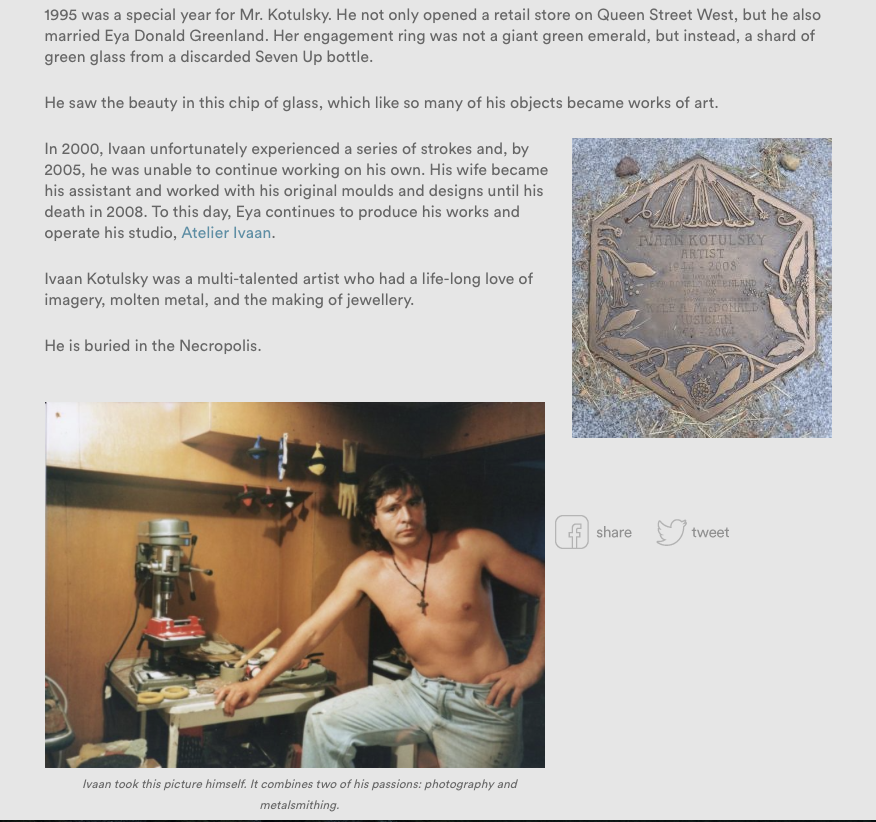
Every time I see this photograph of Ivaan, I say a silent thanks to our friend Slava Lukashenkov, who took the photo in the August before his death. It's art imitating life.  At the very right of the photo, I'm just walking into the frame carrying a plate of food to Ivaan.  Slava captured Ivaan exactly as he looked, and whenever I see this photograph, it's like having Ivaan in the room.

For me, it's off to the cemetery today, to cover Ivaan's grave with a blanket of evergreen boughs.  Got to keep my boys warm for the long, cold winter ahead.  Je ne vous oublierai jamais.

я кохаю тебе мій чоловік дуже дуже дуже. вічна пам'ять.


Monday, October 17, 2016

WHEN THE CAT'S AWAY: Legends of Sault Ste-Marie.

It was probably about 12 years ago that my sister called to ask if Ivaan and I would come up to Sault Ste-Marie for a week to stay at their house with their sons while she and Joe went house-hunting 1000 kilometres away.

Ivaan already used a wheelchair most of the time but he could walk short distances.  There are no short distances in Sault Ste-Marie, but that's another story.  The first leg of our journey was by train to Sudbury.  Then we went by bus to Sault Ste. Marie.  Ivaan loved this part.  Sitting in the front seats on the right hand side, the entire vista of Northern Ontario opened up before his eyes.  "It's like big screen TV" he marvelled.  (We never had television, so this was purely hypothetical).

Lesley and Joe met us at the bus depot, left us with the car and the kids, and they headed off to find a house to buy in Kingston.

On the way up to the Sault, Ivaan worried aloud that the nephews might not cope well with the disruption of having an aunt and uncle in the house instead of Mum and Dad.   He decided that the way to ensure this didn't happen was to pull out all the stops to ensure the week was given over to total enjoyment. (And he hoped the nephews would have a good time, too.)
We had barely arrived in the door when Uncle Ivaan asked, "What things would you like to do this week that probably wouldn't happen if Mum and Dad were here instead of us?"  Fireworks!  said Angus, 13.  Going to the fair after school! chimed in six year old Ivor.  Eating french fries off the chip truck outside Canadian Tire! volunteered Angus.   Tim Hortons Boston Creme doughnuts after violin lessons, added Ivor. Dairy Queen for breakfast, said Angus hopefully. Riding to the school bus stop in the wheelchair! threw in Ivor.

Next morning, it was surprisingly easy to get Ivor ready for school.  In fact, he was standing by the wheelchair 15 minutes before the school bus was due to arrive.  "They'll think I'm a little disabled kid!" he mused enthusiastically, as I pushed him down the long driveway to the school bus stop.

Remembering  how young kids love to be hugged and kissed by their aunties in front of their classmates (not much), I said to him in French as the school bus pulled up, "On peut serrer la main" (we can shake hands).   Imagine my surprise when Ivor leapt out of the wheelchair, bounded up the steps of the school bus, and vigorously shook the hand of Jane, the school bus driver.

We picked the kids up from school and headed straight for the fair.  Ferris wheels, candy floss and carnival games are best enjoyed on an empty stomach.

Next day, it was french fries in the Canadian Tire parking lot.   Then we went to Dairy Queen to pick up breakfast for the following morning.  Violin lessons took slightly longer than normal, as they included a trip to Tim Hortons for a Boston Creme doughnut before returning to school.

The night before Mum and Dad got home, we told the McKechnies, who lived next door, that we were planning a fireworks display.  Concerned, they mentioned some grouchy neighbours a few doors away and the very real chance that the grouchy neighbours would call the police.  We said we thought we'd take a chance anyway.  So that night, the McKechnies held their own fireworks display in solidarity with ours, just in case the cops showed up.  They didn't.

When it was time to meet Mum and Dad at the airport and to head back to Toronto with Ivaan and the wheelchair, we found a sign taped to the front door of the house, written in Ivor's distinctive handwriting:

THE PEOPLE WHO USED TO LIVE HERE HAVE MOVED, it read.  PLEASE GO AWAY.

We took that as a sign that he didn't mind having to put up with his uncle and aunt for an entire week.

CABBAGETOWN: The Stuff of Legends

Two weeks ago, I moved into the house of some close friends in the west end.  The plan was that my friend Crystal would fly out west for a week to help out in the home of one of her sisters, who had just welcomed a new baby.  She'd take her youngest child with her, leaving her husband Matt, their two older children, and me to keep the home fires burning.

We'd done a version of this last year when their own new baby arrived, and it worked really well.  But we'd never tried it for an entire week, and never with Crystal so far away.   Hard to say who was more nervous, but if the kids were nervous, it didn't show at all. In fact, those children are as
cool as cucumbers.  It's hard to imagine that a 7 and a 4 year old could cope so well with Auntie Eya at the helm instead of Mom, but they are troopers.

Crystal had left me with a schedule of the kids' activities and some very helpful suggestions:  Make their lunches the night before!  Anything remaining is their lunch boxes is an after school snack! Don't forget their piano practice!  Brush and floss twice a day!  Homework!  Everyone washes their hands as soon as we get home!  Gymnastics!  Birthday parties!  Swimming! Bedtime at 7:30!  And, best of all, stories before bedtime.

Now, it's important to note that both children were born after Ivaan left the planet.  The seven-year-old was born exactly one month later.  The four-year-old was born exactly three years later.  But Uncle Ivaan is as present in their lives as if they had known him forever.   They know what he looks like.  They know his jokes. They visit his grave and the peonies which flower at his gravesite every June are a gift from them.

So when it came to story time, I didn't even bother to bring out any books to read.  I was going to tell them stories about Uncle Ivaan and the mischief he got up to when he was their age. These stories are better told in the dark.   The story about Ivaan dropping a homemade bomb off the roof of their house.  The story about Ivaan hitching a ride on the back of the vegetable truck.  The story about what a picky eater Ivaan was....until he discovered ham sandwiches made by the mother of his friends Bo and Len.  Seriously, you could have heard a pin drop in that bedroom.  One evening, when Matt arrived home from work, he came into the children's room for a goodnight hug, in the middle of a story.  The seven-year-old was patient for a minute or two, but finally asked, "And now can Auntie Eya finish the story, Dad?"

The week passed in a blur.  The children were thrilled to see their mother and their little brother. We all pronounced the adventure a complete success.

When I arrived back at my very quiet home, I found an email informing me that Uncle Ivaan was now featured in the Remarkable Lives section of the historical website, Cabbagetown People.  I haven't shown it to the children yet, but I'm showing it to you right now.

On the last night before Crystal came home, I told the children the story of when Uncle Ivaan and Auntie Eya went to Sault Ste Marie for a week, to stay with our nephews Angus and Ivor, while my sister and brother-in-law were out of town.  It was quite a few years before the nephews told their
parents the full tale of what happened that week, but now that the truth is out, this will be the subject of my next blog post.

(c) CabbagetownPeople.com


Thursday, September 15, 2016

84


For as long as our family has lived there, it's been known only by its street number: 84.

Our parents bought the house on July 14, 1966 and for the first year it was rented to university students, while we were living in London, England. We arrived in Canada by ocean liner a year later, sailing up the St. Lawrence to the Port of Montreal, passing Expo 67 in full swing. It was evening when we arrived at Union Station: our mother, five children ranging in age from 7 to 15, an uncle, an aunt and two cousins. Our father had remained in London to finish up some research.

I definitely did not want to come to Canada. I loved my school in London, loved my friends and classmates, and beseeched my parents to let me stay behind.  I think our father would have caved, but our mother insisted I come with the rest of the family to Toronto.  London in 1967 was fun. It was exciting. I had never felt as comfortable and alive as I did in London. By contrast, Toronto was staid, provincial and boring.

In London, we wore school uniforms.  As a result, our weekend clothes tended to be much more stylish.  Starting school in Toronto, my wardrobe consisted of the weekend clothes I wore in London.  Clothes from Carnaby Street, Oxford Circus, Selfridges.  Eye popping colours, shorter skirts than any worn in Toronto, bright leather shoes.  I quickly got used to heads turning in the hallways of the local high school. Anything from England was considered cool that year, and I had an English accent which, combined with my clothes, made me stand out, even though I was a couple of years younger than most of my classmates. We also had a copy of The Beatles' Sergeant Pepper's Lonely Hearts Club Band, which had not yet been released in Canada.

But 84. We arrived at 84 to find a large, old, dark, grimy house without basic amenities like light bulbs. I remember my siblings and I trying to wash the walls of the kitchen that night, alarmed at the prospect of having to sleep in what looked like it might have been a haunted house. Next morning, in daylight, we were amazed to see that most of the house was wallpapered in an enormous pattern of olive green fig leaves over white brick.

I quickly claimed the larger attic bedroom for myself.  The rest of the summer was a blur, getting the house cleaned up enough to be habitable. And gradually we settled into what was to be our permanent family home.  I got a part time job, first at the library, then at the local bakery.  And that is where I was when I first met Ivaan two years later.

He came in one Thursday evening in December to buy some dill pickles and a small loaf of light rye bread. Zwei un' dreisig the bread cost, in Yiddish, because it was a Jewish bakery.  Thirty-two cents.  I was working alone in the bakery that evening,  and because it was slow, we began to chat.  He was a photographer, he had gone to my high school a decade earlier, and his family lived a few streets away from mine.  At 25, he seemed like an ancient geezer to me, but he was really interesting and I enjoyed talking to him.

Two days later,  I came home to a phone call from Ivaan.  He wanted to know if I would like to accompany him to the opening of an art exhibition.  I explained that this would necessitate him coming to the house to meet my father.  He seemed agreeable, and shortly thereafter he arrived at the front door.  He and my father retreated to the kitchen for a chat, while I stood in the living room for an inordinate length of time, wringing my hands.  Eventually I poked my head into the kitchen, and found the two of them so engrossed in conversation that they had completely forgotten about me.  Somehow, I secured permission to attend the art exhibition, and it was the start of a friendship with Ivaan that spanned decades.

Ivaan led a big, exciting life.  I was in high school. On the surface, it would be hard to imagine two more unlikely friends.  Years later, I learned that he had told his mother all about my family. My high school friends were impressed. When he learned I liked motorcycles, he gave me his old Harley Davidson.  He came in useful when I needed to scare off too-persistent boyfriends.  He once insisted on attending a high school dance with me, where he showed up reeking of patchouli oil, in full hippie regalia.  Looking back, I realize that Ivaan provided what I was missing when I left London: a bigger, brighter, more exciting life.

So, what does all this have to do with 84?  This month, we put 84 up for sale.  It no longer has the fig leaf wallpaper.  The neighbourhood has gentrified to the point where all the houses are protected by a heritage designation and the only people who can afford to buy a house there are the people who can afford to spend a couple of million.  One day later, the house was sold to a young couple with two boys the ages of my brothers when we first moved to 84.  Three weeks from now, it will be their family home.

We'll be leaving so much behind: the memory of our lovely niece being born there. The memory of our elder brother being married there.  The memory of our mother taking her last breath there.  The memory of the fig leaf wallpaper, some of which still remains on the walls of the upstairs cleaning closet.  I spent a month at 84 this summer, cleaning, repairing and painting it in preparation for the real estate market.  It reminded me of our first night there in 1967, trying to wash the kitchen walls - only this time with light bulbs in place.

But personally, what I'll remember most vividly is that I'm saying goodbye to the house where I waited impatiently in the living room in December of 1969 while my dad and Ivaan seemed to have been talking about everything under the sun except me.  The small rye bread Ivaan bought the evening I first met him at the Harbord Bakery now costs $3.95.

As for 84, I like to think I've honoured our family's years there by leaving it in better condition than I found it in, 50 years ago.  But as the American poet Robert Frost wrote, "Home is the place where, when you have to go there, they have to take you in."

I didn't think it would be bittersweet, but maybe it is after all.